A buyer messages your page at 11pm asking if a two-bedroom unit is still available. By the time you reply the next morning, they have already booked a viewing with another broker.
This is the most common way Philippine real estate businesses lose leads. It is not a lack of effort. Brokers are out on viewings, handling paperwork, or simply asleep when buyers are most active.
AI agents close that gap. They answer enquiries in seconds, any time of day, and hand qualified buyers to a licensed broker. This article covers what that looks like, what the rest of the world is already doing, and the guardrails that matter in a licensed profession.
The real problem is speed, not effort
In October 2026, a Singapore proptech firm sent enquiries to 394 property agents over WhatsApp. Agents who replied personally took an average of 2 hours and 14 minutes. Nearly one in three took over an hour, and the longest wait was 27 hours. About one in five enquiries got no reply at all. (field test results)
The test was run by a company that sells AI assistants, and it was not a random sample. Treat the numbers as a snapshot, not a national average. But any Philippine broker will recognize the pattern.
The finding that matters most for us: only half of the agents contacted from overseas numbers replied personally. In the Philippines, many buyers are OFWs and their families, messaging from Dubai, Riyadh or Toronto at hours when brokers here are asleep.
The industry abroad has already moved. In the US, a three-year survey of brokerage leaders found that only 1.9% have no plans to adopt AI in 2026, down from 10.6% in 2024. (HousingWire)
What an AI agent does for a brokerage
An AI agent is not a chatbot that recites a menu. It reads the buyer's question, answers from your approved listing data, and moves the conversation toward a viewing. A typical enquiry runs like this:
- Answers instantly. Availability, price range, unit sizes, amenities, location and nearby landmarks, in seconds, day or night.
- Qualifies the buyer. Asks about budget, preferred area, move-in timeline, and whether they are buying to live in or to invest.
- Explains the next steps. Reservation process, required documents and payment terms, using only information you have approved.
- Books the viewing. Offers open slots on the broker's calendar and confirms the appointment.
- Hands off to a licensed broker. Sends a summary of the conversation, so the broker starts the call already knowing what the buyer wants.
The broker's time goes to the work that needs a person: viewings, negotiation and closing.
Guardrails: the AI assists, the licensed broker decides
Real estate is a licensed profession. Speed means nothing if the agent oversteps.
The US National Association of REALTORS® raised this exact risk in June 2026. Its chief data officer warned that when licensed activities are built into an automated workflow, an AI tool could proceed without waiting for a licensed practitioner to step in. NAR's advice to brokers: approve the tools agents use, require human review, and publish an AI policy now rather than later. (NAR REALTOR® News)
The same principle applies here, under Philippine rules:
- Real Estate Service Act (RA 9646). Professional advice, negotiation and closing stay with licensed brokers and their accredited salespersons. The AI answers questions and books viewings. It does not give professional advice or negotiate.
- DHSUD License to Sell. For subdivision and condominium projects, the agent should only present projects and terms that are approved and current. It answers from your approved listing data, never from guesses.
- Data Privacy Act (RA 10173). Buyer names, numbers and budgets are personal data. Collect only what you need, tell buyers they are chatting with an AI, and store data securely.
At GuardrailAI, these are not add-ons. Every real estate agent we build has clear limits on what it can say, a handoff to a human for anything outside those limits, and a log of every conversation.
Why the Philippines needs its own approach
Most AI tools for real estate are built for US or European buyers. Philippine buyers behave differently:
- Messenger first. Many enquiries start on a Facebook page or Messenger, not on email or a website form. The agent has to live where buyers already are.
- OFW buyers across time zones. A buyer in the Middle East or North America messages during our night. An AI agent gives them the same fast reply a local buyer gets.
- Taglish. Buyers switch between English and Filipino mid-sentence. "Magkano po ang 2BR, may parking ba?" needs a natural answer, not a confused one.
- Family decisions. A purchase often involves parents, siblings or a spouse abroad. The agent can share clear details the buyer can forward to the family group chat.
Philippine brokers are paying attention. In November 2026, a Philippine delegation is attending the NAR NXT convention in the US to learn how AI can streamline brokerage operations and bring those lessons home. (SunStar)
See it in action: Reese for Sunrise Realty
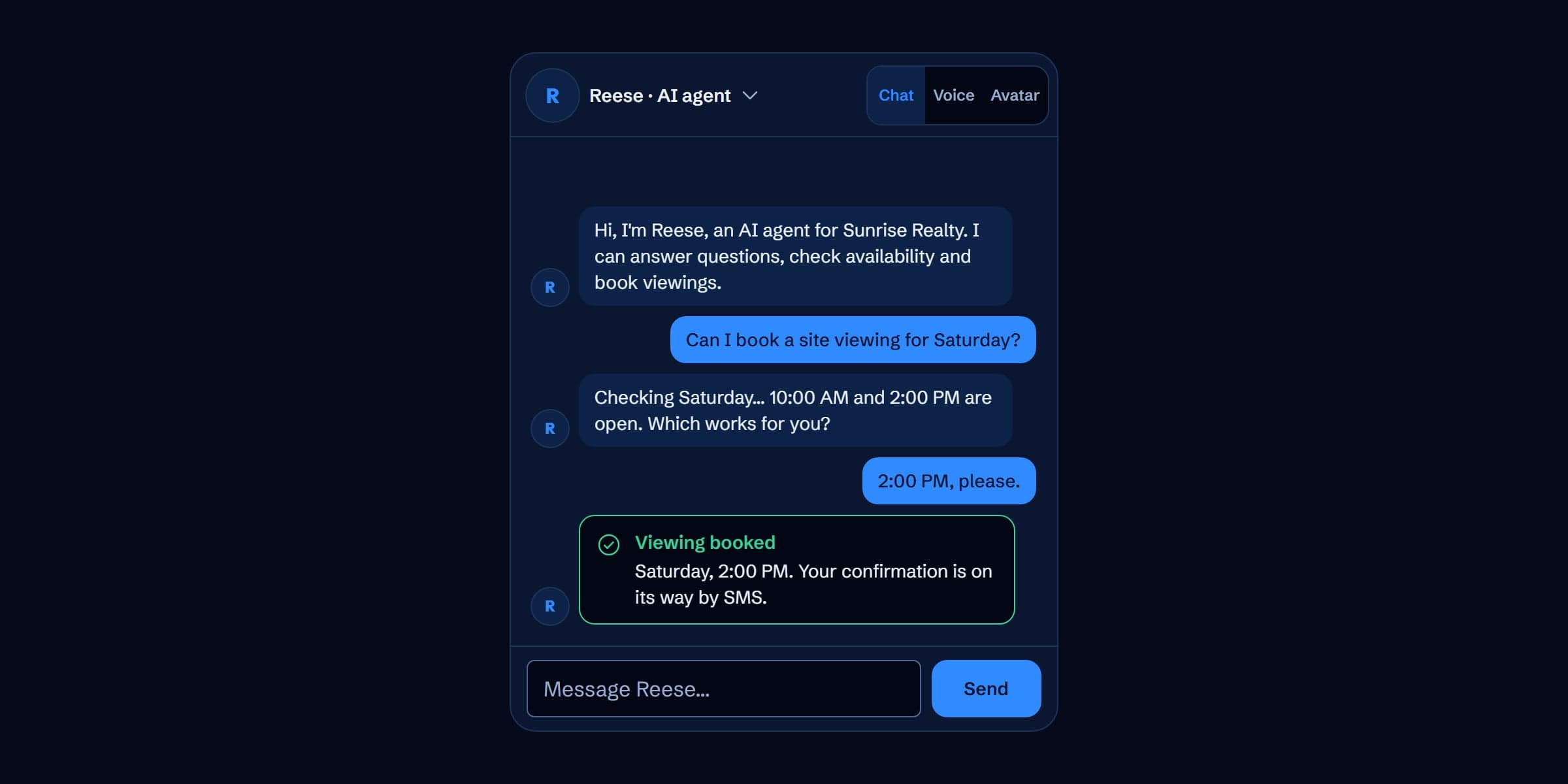
On our homepage, you can see Reese, a sample AI agent we built for a fictional brokerage, Sunrise Realty. It shows how an agent answers the questions buyers ask most:
Buyer: Hi, available pa po ba yung 2BR sa Quezon City? Magkano?
Reese: Hi! Yes, we still have 2-bedroom units available. Prices start at the range listed on our project page, and I can share the current price list. Are you looking to live in it or as an investment?
Buyer: For my parents, I'm working in Dubai.
Reese: Got it. I can send you the floor plans and payment terms now, and one of our licensed brokers can schedule a video call at a time that works for you in Dubai.
Every answer comes from the brokerage's approved information. When the buyer is ready for advice or negotiation, Reese hands them to a licensed broker.
How to start
You don't need to automate your whole brokerage. Start with the work that loses you the most leads:
- Pick one channel. Usually your Facebook page and Messenger, where most enquiries arrive.
- Gather your approved information. Current listings, price ranges, payment terms, FAQs and reservation steps.
- Set the limits. Decide what the agent can answer and when it must hand off to a licensed broker.
- Go live and review. Read the conversation logs every week for the first month and tighten the answers.
- Expand. Add viewing bookings, your website and WhatsApp once the first channel is working.
Related: Why PH-first AI agents matter
Ready to stop losing late-night leads? Book a free consultation and we'll show you what an AI agent for your brokerage would look like.
Written by the GuardrailAI team.
Sources
- Rivo AI launches WhatsApp assistant as study finds Singapore property agents take over two hours on average to reply, Media OutReach Newswire, Oct 27, 2026
- Real estate brokerage AI adoption hits a tipping point as holdouts disappear, HousingWire, Aug 6, 2026
- AI's Current Iteration Poses Higher Risk—and Reward—for Brokers, NAR REALTOR® News, Jun 16, 2026
- PH delegation to explore AI in US real estate convention, SunStar, Nov 2026

Related articles

Why Every Small Business in the Philippines Needs an AI Agent in 2026
How Filipino Event Planners Are Using AI to Scale Their Businesses Without Burning Out

Banking on AI: How Philippine Financial Institutions Can Build Future-Ready Infrastructure

Agentic AI Is Coming to Southeast Asia. Is Your Business Ready?

AI Agents for Philippine Accounting Firms: Answer Clients Faster, Keep CPAs in Charge

AI Agents for Philippine Clinics: Fill Your Schedule, Keep Doctors in Charge

PH-First AI Agents: Why Global AI Tools Don't Fit Philippine Businesses

Where to Start with AI: A Practical Guide for Philippine Businesses
Put an AI agent to work, with guardrails.
Let's talk.